
Just after 7:45 a.m. on November 14, 2025, land gave way behind a building in the 400 block of Elliott Avenue West, on Queen Anne's western slope. Rain was falling at roughly a quarter inch an hour, among the heaviest bursts of that week, and by the time Seattle Fire crews cleared storm drains and handed the scene to inspectors, the building at 423 W. Republican Street had been yellow-tagged by the Seattle Department of Construction and Inspections' geotech team. The westside sidewalk stayed closed until temporary stabilization work went in. Seattle Public Utilities, SDCI, and the Seattle Department of Transportation all had a hand in sorting out what happened, and SDCI's own statement afterward was blunt: property owners on steep hillsides should be checking their slopes regularly through the wet season, watching for fresh cracks in the soil and trees that have started to lean.
That address sits on ground the city has been watching for decades. SDCI's landslide study, which mapped the hill's slide history block by block, names Southwest Queen Anne among the handful of Seattle neighborhoods it classifies as a chronic slide area, alongside East Queen Anne, Southwest Magnolia, and a short list of other slopes around the city. The November incident was not a freak event on an otherwise stable hillside. It was one entry in a pattern SDCI has been documenting since before most current listings existed.
For anyone buying or selling on Queen Anne's slope side this fall, that pattern matters more than the view from the deck.
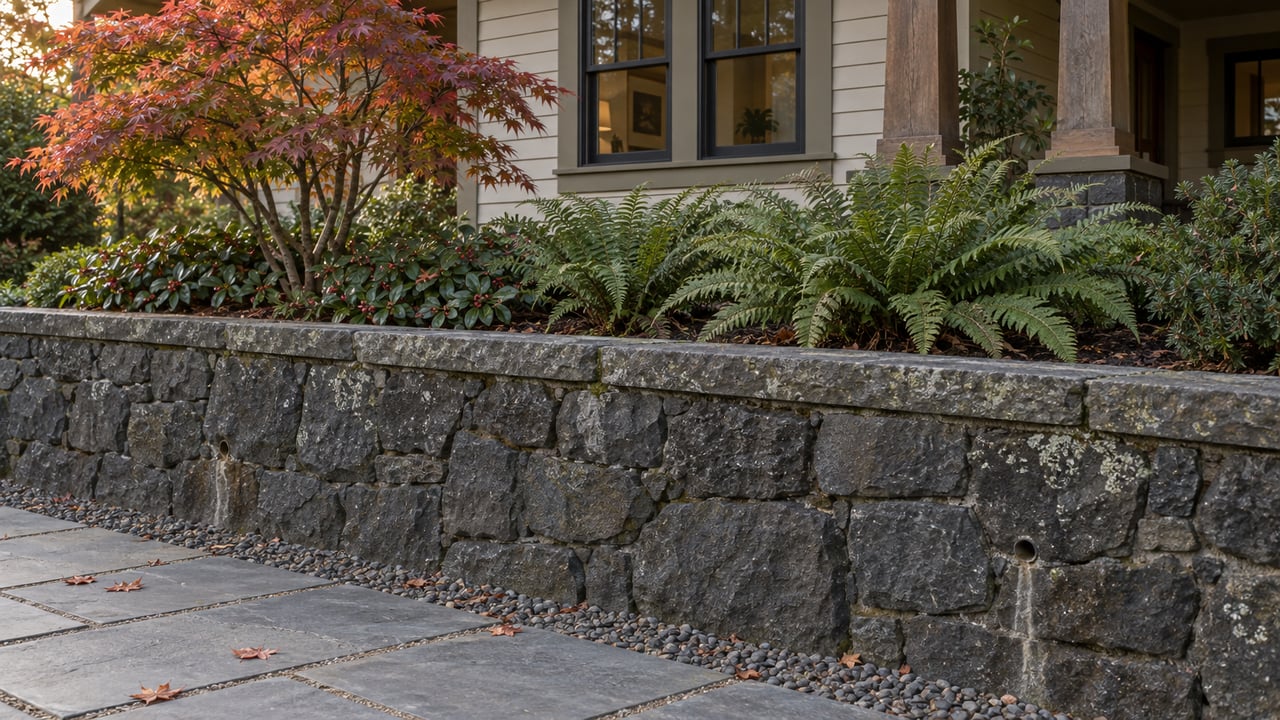
Queen Anne's terrain forces a lot of retaining wall into a small footprint. Upper Queen Anne sits on a hilltop, and the streets that fall away from it toward Elliott Bay, Interbay, and Lake Union carry stepped foundations, cut driveways, and rockeries that hold the grade in place. Seattle's building code treats these walls the same way regardless of how good they look: a wall four feet or shorter, measured from the buried bottom of the footing to the top, generally does not need a construction permit, but only if the parcel sits outside an Environmentally Critical Area and the work will not risk damage to a neighboring structure.
According to Seattle Rockeries, Queen Anne's steep-slope zones, the ones mapped at a 40 percent grade or greater over at least ten vertical feet, are Environmentally Critical Areas under the city code. Inside one of those zones, a wall may require a permit.
What this means in practice is that a retaining wall's current condition tells a buyer almost nothing about its legal standing. A wall built decades ago, before today's ECA mapping existed, may never have gone through this review at all. It can look solid and still carry no permit history, which becomes the seller's problem to explain and the buyer's problem to underwrite if something goes wrong later.
Seattle sits on a specific geologic layer cake: loose outwash sand and gravel over dense Vashon glacial till, the compact hardpan most homeowners eventually hit with a shovel. Rain moves down through the loose upper soil, reaches that till layer, and cannot keep draining straight down, so it perches there and pushes sideways instead. On flat ground that shows up as a wet basement. On a slope, it is the mechanism behind nearly every leaning rockery and cracked retaining wall in the city, and it runs hardest from November through March, which is exactly when SDCI logged the Republican Street slide.
A wall without real drainage, meaning a perforated pipe at the footing, clean gravel backfill, and an outlet that actually daylights somewhere, builds up hydrostatic pressure until it bulges, cracks, or slides. That is a physical fact about the hill, not a defect specific to any one property, and it explains why a wall that has stood fine through three dry summers can fail in a single wet winter.
The repair math is real money. A geotechnical soils report, common on steep or ECA-mapped lots, runs $1,500 to $4,000. According to Green Spaces, SDCI permit fees for a wall requiring engineering scale with project valuation, typically landing between $180 and $1,000 or more. Installation itself runs $35 to $150 or more per square foot depending on material and site access, and a narrow Queen Anne side yard that only fits a wheelbarrow instead of a mini excavator adds labor time on top of that. None of these numbers belong in a listing description, but they belong in a seller's planning six months before one, and in a buyer's mental math before writing an offer that assumes the wall is fine because it looks fine today.
Washington sellers complete a Residential Real Property Disclosure Statement, commonly called Form 17, required under RCW 64.06 since 1995. It has to reach the buyer following mutual acceptance, and according to Fennemore Law, the buyer then has three business days to rescind based on what it says. The form includes an Environmental section. According to Nolo, the Environmental section includes questions covering flooding, drainage problems, and material damage from events like landslides.
On a Queen Anne slope property, that section is doing more work than it does almost anywhere else in the city. A seller who knows about a past slide, a wall repair, or standing water after storms has information relevant to that section, and a buyer who receives a disclosure with something checked "yes" in that section has reason to review it carefully. A clean Form 17 on a steep lot is worth confirming rather than assuming, since a geotech report might eventually find something the form does not address.
Core Queen Anne and West Queen Anne are tracked as separate submarkets, and this fall they are behaving like separate markets. Over the three months ending August 2026, core Queen Anne homes sold at a median of $1.0 million, down 4.5 percent from the same period a year earlier, moving in about 19 days on average. West Queen Anne told a different story over that same window: a three-month median of $992,000, down 23.5 percent year over year, on just 19 closed sales compared to 37 the year before, nearly half the volume.
Some of that gap is simply the citywide reset playing out. Seattle crossed back above four months of resale supply in August 2026 for the first time in more than fourteen years, and buyers across the city have more room to negotiate than they did a year ago. West Queen Anne's blocks run down toward Elliott Bay and Interbay, into the same southwest-facing terrain SDCI has logged as chronic slide ground for decades, and the November landslide sits on that same slope. For a specific property, wall history, ECA status, and due-diligence needs are matters to review individually alongside the market information above.
For a specific property, build time for that review into the timeline from the start rather than discovering the need during inspection.
If you are selling a slope property on Queen Anne this fall, the strongest move is getting ahead of the paperwork rather than reacting to an inspector's questions. Pull any existing permit history on retaining walls before you list. If none exists and the wall sits in a mapped ECA, a geotechnical evaluation done on your terms, before an offer, reads very differently to a buyer than one triggered by their inspector during the option period.
If you are buying, ask for the wall's permit history specifically, not just a walk-around look at its condition. A wall with no permit history is a question worth answering before removing your inspection contingency.
One more wrinkle worth knowing if repairs surface during inspection: Seattle moved side sewer permitting and inspections from SDCI to Seattle Public Utilities as of October 1, 2025. Many of Queen Anne's older homes are due for side sewer attention on age alone, and if a repair permit becomes part of your closing timeline, it now routes through SPU rather than the department most out-of-town buyers and their lenders expect.
Does a documented slide history automatically sink a Queen Anne sale? No. It changes the negotiation, not the outcome. Buyers price certainty, and a seller who arrives with an engineer's report already in hand usually keeps more of the asking price than one who lets the buyer's inspector find the issue first.
How do I find out if my specific block is in a mapped Environmentally Critical Area? SDCI maintains a GIS lookup by parcel, and it is worth checking before assuming a wall project or a sale timeline will move at the pace a flat-lot transaction would.
What if the seller answers "don't know" on the environmental questions? Treat "don't know" as a prompt to bring in your own geotech or structural professional during the inspection period, not a red flag on its own.
The view sells the house on Queen Anne's west-facing blocks. The wall behind it, and the paper trail attached to that wall, decides what the house actually closes for. If you are weighing a purchase or a listing on one of these slopes and want a clear read on what the permit history and the disclosure form are actually telling you, Anastasia Miles has spent years walking Queen Anne's steep streets with clients before the offer, not after the inspection report lands.
This article is general information, not legal, tax or financial advice. Consult a qualified professional about your situation.

Whether you're buying or selling, I offer the market knowledge, resources, and support needed to help you make informed decisions. My goal is to simplify the process, anticipate challenges, and create a seamless experience tailored to your unique needs.

3933 LAKE WASHINGTON BLVD NE KIRKLAND, WA 98033