
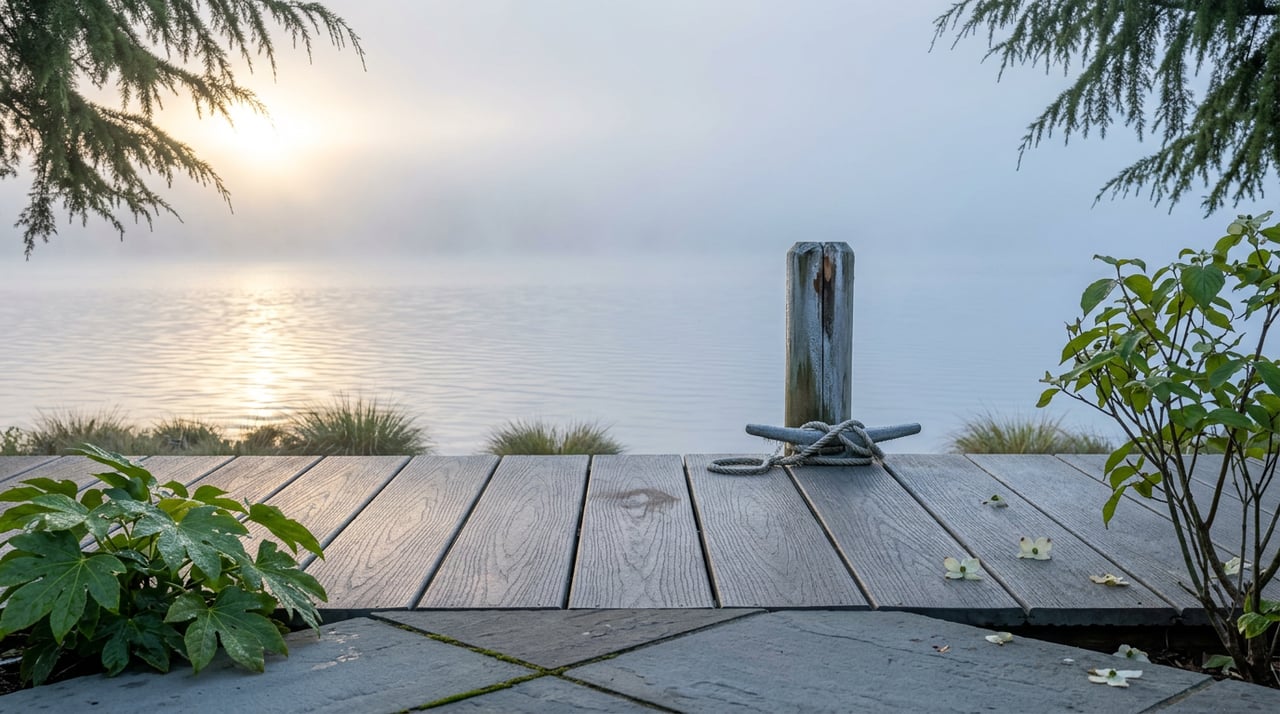
The showing usually goes the same way. The buyer walks through the staged living room, glances at the kitchen, and heads straight for the glass doors facing Lake Washington. They stand on the deck for a long minute. Then they ask about the dock, and that is the moment the conversation actually starts, because the dock is rarely just a dock. In Kirkland, it is a structure that can answer to four separate government bodies before a single board gets replaced, and whether that paperwork exists, or doesn't, shapes the deal far more than the buyer standing on the deck usually realizes.
Most waterfront conversations focus on square footage, finishes, and how many feet of shoreline come with the parcel. Those numbers matter, but they aren't where the friction lives. The friction lives in permit history, because in Kirkland, any development along the shoreline, including dock repair, bulkhead work, or a boat lift upgrade, falls under the city's Shoreline Master Program and can require sign-off from the City of Kirkland, the Washington State Department of Ecology, the U.S. Army Corps of Engineers, and consultation with the Muckleshoot Indian Tribe's Fisheries Division. A buyer who assumes a dock is a simple maintenance item is often looking at a structure with a permit trail as complicated as the house itself.
Here is what actually reviews a Kirkland dock project, and why:
| Authority | What It Reviews | What Triggers Its Involvement |
|---|---|---|
| City of Kirkland (Shoreline Management, KZC Chapter 83) | Any development within the shoreline jurisdiction, including docks, bulkheads, and decks | Construction, repair, or alteration on shoreline-adjacent property |
| Washington Department of Ecology | Consistency with the state Shoreline Management Act | Substantial Development Permit applications and appeals |
| U.S. Army Corps of Engineers | Federal waters, fish habitat, and Endangered Species Act consultation | Any dock work involving piling or fill in Lake Washington |
| Muckleshoot Indian Tribe Fisheries Division | Treaty fishing rights and habitat impact | Consulted on shoreline permit applications that affect fish habitat |
None of these bodies works in isolation. A single dock repair application in Kirkland is routinely copied to the Department of Ecology's shoreline permit review desk and to the Tribe's Watersheds and Land Use team at the same time it goes to the city's planning department. That is not a hypothetical process. It is the actual distribution list on permit files sitting in the city's own records right now.
Washington state sets a dollar threshold that determines whether a dock project needs the full Substantial Development Permit process or can move through a lighter exemption path. Since August 2023, that threshold has been $28,000 for residential dock construction or replacement in fresh water, and $13,900 for other docks, a figure the state adjusts for inflation every five years, with the next adjustment due in 2028.
The number matters because most real waterfront repair work in Kirkland clears it before a contractor even shows up. Bulkhead replacement typically runs $500 to $1,500 per linear foot, which means a modest 75 feet of shoreline can carry a bulkhead repair bill of $37,500 to $112,500. Deck and dock structure repairs tied to moisture damage, a documented vulnerability in homes close to Lake Washington, commonly land in the $40,000 to $60,000 range. Both figures sit well above the $28,000 line. That means a large share of the substantial repair work happening on Kirkland's waterfront right now isn't quietly exempt. It's squarely in full-review territory, with the city, the state, and potentially the Tribe all weighing in before work begins.
The city's permit files make this concrete. A recent Homeport Marina dock maintenance application, filed with the city in April 2026 for repair work performed by Waterfront Construction Inc., was distributed for shoreline permit review at the Department of Ecology and to the Muckleshoot Tribe's Watersheds and Land Use team leader as a matter of course, alongside the standard SEPA environmental checklist routing.
A separate Kirkland case involving a shared dock serving three condominium buildings, filed under the city's shoreline review process, shows just how granular the standards get. The pier in that case serves 26 boat slips across 73 condominium units, and the staff review applied specific rules: only one pier or dock is allowed per property, moorage piles must sit at least 5 feet from the side property line, and other structures require a 10-foot setback. These aren't abstractions written into a code book somewhere. They are the literal line items a city planner checks against a specific dock before signing off on a specific repair.
A dock's permit file often tells a buyer more about a property's true condition than the listing photos do.
Kirkland's price tiers already reflect how much water access is worth. Waterfront and view homes on Lake Washington trade in the $2 million to $7 million-plus range, while comparable inland Kirkland homes run $850,000 to $1.3 million. Within the waterfront tier itself, the spread is even sharper. In Juanita, homes with direct lake views or dock access regularly top $3 million, while solid single-family homes in the same neighborhood without water access run $1.5 million to $2 million. West of Market and Houghton carry some of the city's highest per-square-foot premiums, with list prices commonly starting above $1.5 million and exceeding $2.5 million for the most desirable water-adjacent parcels.
What that price spread is actually buying isn't just a view. It's a bundle of usable, permitted water access, and that bundle is only as solid as its paperwork. A seller who has kept documentation of a properly permitted bulkhead repair or dock replacement is offering a buyer something real: a structure whose condition and legal status have already been tested against city, state, and sometimes federal review. A seller who cannot produce that history, or who has unpermitted work sitting quietly behind a deck that looks fine from the water, is transferring risk directly to the buyer. That risk shows up later, often during inspection, when a deck or dock structural issue becomes the centerpiece of a negotiation the buyer didn't see coming.
Before writing an offer on Kirkland waterfront property, it is worth requesting:
A seller who can hand over a clean answer to all four is offering more than a view. A seller who can't is asking the buyer to underwrite an unknown.
Does a small repair, like replacing a few dock boards, really need a permit? It depends on scope and cost. Routine maintenance that doesn't add fill or exceed the state's dollar threshold may qualify for an exemption, but any work involving new piling, added structure, or a project value near or above the threshold typically requires full review.
What happens if a previous owner did dock work without a permit? It becomes the current owner's problem to resolve, and by extension, the buyer's problem if it surfaces during due diligence. Unpermitted shoreline work can complicate insurance, financing, or a future sale until it is documented or brought into compliance.
Does this apply to shared or community docks in condo buildings? Yes. Shared piers serving multiple units go through the same city and state review as a single-family dock, often with additional standards around slip allocation and setbacks tied to the number of units they serve.
Waterfront property in Kirkland rewards buyers and sellers who treat the dock as seriously as the house. If you're weighing a purchase on Lake Washington, or preparing to sell a home where the shoreline is part of the value, Anastasia Miles can walk you through what a property's permit history actually says about its condition, and what that means for your offer or your listing price. Work with Anastasia.


Whether you're buying or selling, I offer the market knowledge, resources, and support needed to help you make informed decisions. My goal is to simplify the process, anticipate challenges, and create a seamless experience tailored to your unique needs.

3933 LAKE WASHINGTON BLVD NE KIRKLAND, WA 98033