
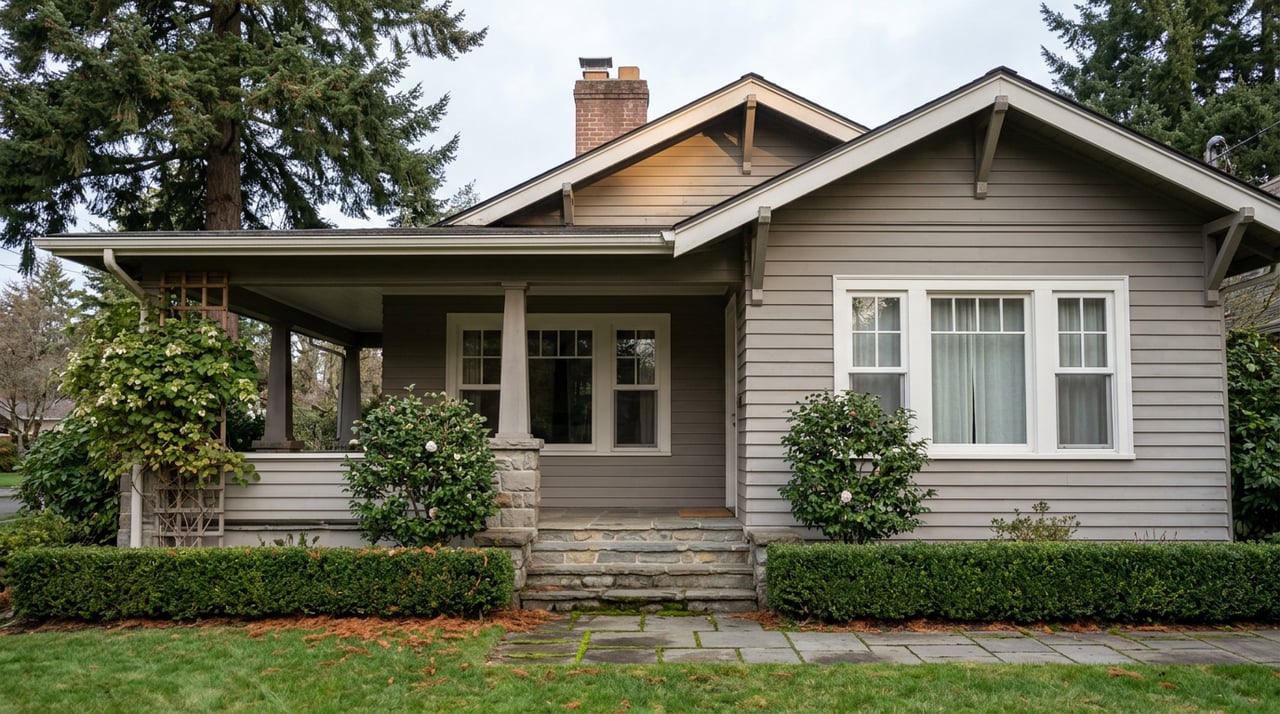
Walk down one of Madison Park's interior residential blocks this fall and you will likely see the same thing you saw last fall: a 1920s Craftsman here, a mid-century rambler there, generous setbacks, mature trees leaning over the sidewalk. Nothing about the streetscape announces that the legal rules governing that lot changed in a fundamental way back in January. Walk two minutes further, into the small commercial village along East Madison Street, and you will find the same thing too: the bakery, the pizzeria, the ice cream counter, all still one and two stories, all still exactly as tall as they were the day before the city's most contested zoning debate in years supposedly reached its conclusion.
Both of those observations are accurate, and both of them are misleading in opposite directions. One part of Madison Park's zoning, as the Seattle Office of Planning & Community Development confirms, changed permanently. The other part, the one generating most of the anxiety and most of the headlines, has not changed at all and remains delayed, with Councilmember Eddie Lin confirming Phase 2 is delayed until 2027 at the earliest. Buyers and sellers who conflate the two are pricing the wrong risk.
On December 16, 2025, the Seattle City Council adopted the Permanent State Zoning Compliance legislation, and it took effect on January 21, 2026. This closed out the city's response to Washington's statewide middle housing mandate, House Bill 1110, which required cities to allow duplexes, triplexes, fourplexes, townhomes, cottage housing, and stacked flats in zones that had been restricted to single detached houses.
In practical terms, Cascade PBS reports that lots can hold up to six units if two are priced below market rate. Architects who track this kind of shift have said the more likely early pattern is redevelopment of larger lots with aging post-war structures rather than a wholesale teardown of every block at once. For a neighborhood defined by lakefront estates and century-old lots, that is a meaningful but slow-moving shift, not an overnight one.
The change most Madison Park residents actually worry about is a different piece of legislation entirely, and it has not become law.
According to Capitol Hill Seattle, the city's second phase of comprehensive plan updates, known as Centers and Corridors, would designate Madison Park as one of 30 new "Neighborhood Centers" citywide, alongside Montlake, Madison Valley, and Madrona. Inside that designation, the plan allows mixed-use buildings up to six stories in the core and four to five stories toward the edges. Mayor Katie Wilson's office transmitted the final proposal to Council on January 28, 2026, framing it as a way to add apartments and condominiums near transit, shops, and services.
By April, Capitol Hill Seattle reported Wilson was pushing to move faster, not slower. She directed the city's planning office to combine the remaining phases and described the approach in blunt terms as "taller, denser, faster," with a goal of having rezoning legislation in motion by 2027 instead of 2028.
Then, in June 2026, a Washington Court of Appeals ruling reopened environmental review of the growth plan changes, finding that certain procedural steps in the city's process were not exempt from state environmental review after all. Land use committee chair Councilmember Eddie Lin announced the committee's remaining 2026 meetings were being canceled and confirmed that Phase 2 is now delayed until 2027 at the earliest. The neighborhood group Friends of Madison Park, which had already filed an appeal against the plan's environmental impact statement back in January 2025 and has spent months walking the neighborhood with city planning staff to raise questions about sewer capacity and tree canopy, now finds itself with more runway than the mayor's April timeline suggested it would get.
Here is the comparison that matters for anyone evaluating property in Madison Park right now:
| Phase 1: Middle Housing | Phase 2: Centers and Corridors | |
|---|---|---|
| Status | Permanent law | Delayed by litigation |
| Effective | January 21, 2026 | Targeted for 2027, now further paused |
| What it allows | Up to 6 units if two are priced below market rate | Up to 6 stories in the village core, 4 to 5 stories at the edges |
| Visible change so far | Very little, redevelopment takes time | None, it has not been enacted |
The Centers and Corridors plan has not been enacted and is delayed until 2027 at the earliest.
If you have tried to research Madison Park home values recently, you have probably noticed the numbers do not agree with each other, and the disagreement is not a data error. It is a symptom of the same underlying condition that makes the zoning story easy to misread: very few transactions.
In February 2026, one major tracker recorded a median sale price of $1.6 million in Madison Park, down 11.4 percent year over year, with homes taking an average of 77 days to sell compared with 47 days the prior year. That same source counted only 8 homes sold that month, down from 13 a year earlier. By July 2026, a different market update pegged the median sale price closer to $1.28 million with a median of just 8 days on market and roughly 95 active listings in the zip code. By August 2026, Movoto's tracking showed median days on market falling to 38, a 19 percent drop year over year, while median list price fell 25 percent to $969,000. Zillow's home value index, refreshed through the end of June 2026, showed the average home value essentially flat, down half a percent year over year, at just over $1.8 million.
A median list price under a million and a median sale price over $1.6 million within the same calendar year do not, by themselves, show a market correcting itself. They are different measures. A neighborhood selling a small enough number of homes each month can see one estate sale or one entry-level condo swing the median sale price on its own. Multiple sources tracking Madison Park explicitly flag this: month-to-month medians here can swing meaningfully given low sales volume. That caveat is doing a lot of work. It means the median sale price in any given month tells you less about where the market is going and more about which handful of properties happened to close.
For a seller holding an interior lot with an older structure, the middle housing change is worth a real conversation before you list, because it changes what a buyer's pool looks like. A larger lot that once appealed only to a single-family buyer now also appeals to a small-scale developer thinking about a fourplex or a set of stacked flats. That is a different negotiation than the one Madison Park sellers were having a year ago, even if the house itself looks the same.
For a buyer comparing Madison Park against Broadmoor, Denny Blaine, or Washington Park, which share the market's price point and character, the calculus is not identical across all four. Broadmoor and Madison Park are sometimes discussed together but should not be evaluated as interchangeable. If what you are buying is quiet and low density, ask specifically what applies to the parcel you are looking at rather than assuming the neighborhood label settles the question.
And if the reason Madison Park appealed to you was its walkable village core exactly as it looks today, the honest answer is that the plan to change it has been delayed, not defeated. A year of runway is not the same as permanence. It is worth deciding whether you are buying into the neighborhood as it exists right now, or assuming it stays that way indefinitely.
When will the village core actually see taller buildings, if ever? No one can say with certainty. The Centers and Corridors legislation was delayed to 2027 by the June 2026 Court of Appeals ruling, and further litigation could extend that timeline again. Treat any specific year as a target, not a guarantee.
Should I wait to buy or sell until the zoning picture is settled? Full certainty in Seattle's zoning process remains elusive, and there is no indication the picture will resolve cleanly. The more useful question is what applies to your specific parcel today, not what might apply eventually.
Madison Park rewards buyers and sellers who look past the label on the neighborhood and into the specifics of the parcel, the timeline, and the handful of sales actually driving the number on the screen. If you are trying to make sense of what a specific lot, listing, or comparable sale actually means in this market, Anastasia Miles has spent her career doing exactly that kind of close reading for Seattle and Eastside clients. Work with Anastasia.
This article is general information, not legal, tax or financial advice. Consult a qualified professional about your situation.


Whether you're buying or selling, I offer the market knowledge, resources, and support needed to help you make informed decisions. My goal is to simplify the process, anticipate challenges, and create a seamless experience tailored to your unique needs.

3933 LAKE WASHINGTON BLVD NE KIRKLAND, WA 98033